TestReach Tutorials are now available for candidates

Generic tutorials of the TestReach system are now available on the RCoA website for candidates who wish to view the system prior to receiving a personal log in three weeks before the test date.  There are tutorials for standard delivery, dyslexia and candidates with sight issues.

The tutorials are in TestReach’s Flexible canvas, which will be used for the live test. In this canvas, candidates can adjust the panel size and highlight and annotate text.

Calculators are not permitted in the examinations, therefore the calculator option shown in these tutorials will not be available in the live version of the test. 

With kind regards

The Exams Team

Fiona Daniels  |  Head of Examinations Royal College of Anaesthetists Telephone: +44 20 7092 1566  |  Web: www.rcoa.ac.uk  
Karen Morris​  |  Regional Representatives Coordinator Royal College of Anaesthetists Churchill House | 35 Red Lion Square London | WC1R 4SG Email: kmorris@rcoa.ac.uk Direct Line: +44 20 7092 1573

Consultant Anaesthetist At Forefront Of Ground-Breaking Coronavirus Genetics Study

More than 170 NHS hospitals are involved with a ground-breaking genetics study in the fight against Coronavirus. GenOMICC (Genetics Of Mortality In Critical Care) aims to sequence the genomes of 20,000 people severely ill with COVID-19. The study will help clinicians to gain a better understanding of people’s varying susceptibility to the disease, as well as its differing effects, and support the search for treatments. Staff from UHNM’s research team work on the frontline in Critical Care to recruit patients at the most serious stage of the disease.

Dr Nageswar Bandla, Consultant in Critical Care and Anaesthetics, and Principal Investigator for the GenOMICC  study at UHNM, said: “Susceptibility to COVID-19 is almost certainly, in part, genetic. GenOMICC can find the genes that cause susceptibility, which may help us to prioritise treatments to respond to the global crisis. Since 2016, the open, global GenOMICC collaboration has been recruiting patients with emerging infections, including COVID-19. Any COVID-19 patient requiring continuous cardiorespiratory monitoring or invasive mechanical ventilation are eligible for inclusion.

“Our research team work on the frontline, putting themselves  in harm’s way to sign patients up to the trial. They do this because they know that every piece of data we gather will help in our fight. We need to look at DNA from thousands of people to find the genes which cause susceptibility to COVID-19 and other infectious diseases. This is urgent because if we can achieve it, we may be able to find treatments that will ultimately save lives.”

UHNM has so far recruited 29 patients to the study. The ground-breaking research may help explain why some patients with COVID-19 experience a mild infection, while others require intensive care and for some it is sadly fatal. By discovering why some are predisposed to developing life-threatening symptoms, the initiative will enable new insights into how the virus works, as well as possible human factors that influence the effects of the disease – and whether a combination of both shape outcomes for patients.

Professor Jeremy Kirk, Clinical Director of the NIHR (National Institute for Health Research) Clinical Research Network West Midlands said: “This is a fantastic recruitment effort by the team at UHNM.  We have supported them to get this study up and running in a very short time and hope that their contribution and that of the patients will soon produce new insights into COVID-19.”

Dr Kenneth Baillie, Chief Investigator on the GenOMICC study, said: “Our genes play a role in determining who becomes desperately sick with infections like COVID-19. Understanding these genes will help us to choose treatments for clinical trials.  We are now recruiting in over 170 ICUs across the country and I am delighted to be working with UHNM to deliver this important work.”

Chris Wigley, CEO of Genomics England said: “NHS Trusts are absolutely vital to the national response to this terrible pandemic, so I am extremely glad that UHNM has joined our efforts to gain new insights into how this virus affects us. With their help, and with the support and understanding of thousands of patients and their families, we hope we will be able to build identify treatments which have the best chance of success in clinical trials, and build on the work of the 100,000 Genomes Project to develop strong infrastructure for the future.”

Covid-19 – Cancellation of Regional Teaching Effective Immediately

Please see attached letter, which has been emailed out to all, today. Note that it includes the cancellation of tomorrows Primary Teaching at Royal Stoke (Thu 12 March 2020). Apologies for the short notice but i’m sure you will understand the reasons. Please ensure your rota master/college tutor are aware you are now available to be redeployed as you will not be attending these teaching sessions. If you have any questions, please don’t hesitate to contact the Stoke School of Anaesthesia Admin’ Office.

Welcome Home From Mercy Ship Mission, Dr Avann

Dr Felicity Avann, an Anaesthetic Trainee at UHNM has been helping Senegalese people on the Africa Mercy Ship. Mercy Ships is an international charity that deploys hospital ships staffed by volunteers to help those in low-income and lower-middle-income countries have access to basic surgical care. During her time on the ship Felicity helped to run three operating theatres anaesthetising for maxillofacial, general surgery, plastic surgery and ENT operations and has found it incredibly rewarding. She said: “While I was on the ship I helped teach local Senegal anaesthetic nurses and doctors and I was also honoured to give a presentation at the weekly anaesthetic seminar. I was very impressed by the dedication and professionalism of the volunteers and I highly recommend it to anyone.”

Chief Executive Award

A child’s life has been saved, thanks to the quick action of staff in UHNM’s emergency care centre. The patient, who had sustained a traumatic brain injury, received essential expert care from Royal Stoke’s emergency medicine team, spending less than 60 minutes at the site before being quickly transferred to Birmingham Children’s Hospital. Over an intensive 30-minute period, a range of staff from across the field of emergency medicine came together to analyse the extent of the child’s injuries and administer lifesaving care.

Earlier in the year, Dr Chinery and colleagues had been training in County Hospital’s Extended Reality Lab (ERL), where by coincidence they had worked on a simulation which covered very similar circumstances. The lab offers an immersive virtual reality training experience and allows any setting to be projected onto blank walls, taking away the need for lengthy set up when providing simulated training in a ward, emergency resus area or pre-hospital environment.

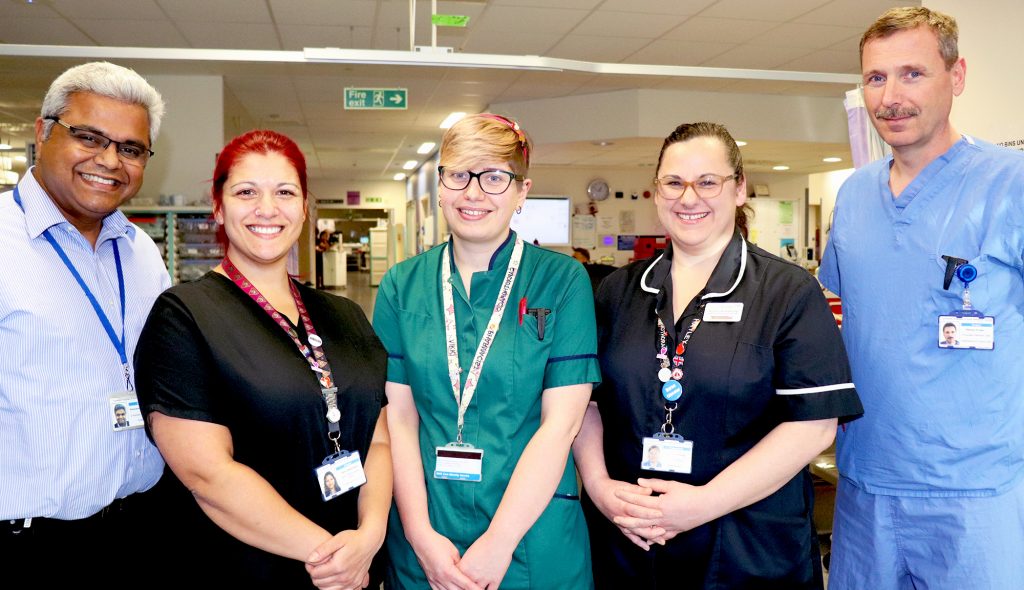
Dr James Chinery, (far left), Consultant in Trauma Anaesthesia and pre-hospital emergency medicine, said: “The training we had undertaken at the ERL had a direct benefit to this patient’s care as it meant we were able to put the right processes in place as quickly as possible. However, knowing what to do would have counted for little without the impressive work of the team of Outreach, Adult, and Children’s emergency nursing staff, who were all outstanding. I am particularly grateful to Helen Bloor, who ably accompanied me on the transfer and to my colleague Dr Mike Greenway, who volunteered to cover Code Red trauma calls during my absence from the hospital whilst I undertook the transfer. This is a moment where I felt truly proud to care. I had a sense that we had delivered something really impressive for this lad, giving him the very best of medical and nursing care, something which we should all be genuinely proud of as an organisation.”

The team have been given the Chief Executive’s Award in recognition of their services.

Tracy Bullock, Chief Executive, said: “I remember hearing about this and just thinking “wow!”  This award epitomises the great skill and expertise that these guys have, as well as the passion for caring for our patients. Their work has a huge impact on patients’ lives and in this case the young man that needed their help. I really thank them for all that they do.”

Critical Care Pioneers Innovative Sedation Device

UHNM’s critical care unit is pioneering the use of an innovative new device called ‘AnaConDa’ (Anaesthetic Conserving Device). The product offers a unique way of sedating patients and is set to particularly benefit those with multiple complications as well as reduce patient time in intensive care. Critical care team members travelled to Germany last year to learn more about the device and see it in use. Only five other NHS Trusts in the UK currently use it.

Dr Bala Murali, Consultant Anaesthetist, said: “The AnaConDa device allows us to sedate patients with anaesthetic gas via a ventilator as opposed to the traditional method of intravenous sedation. Use of the device in this pilot programme marks a huge advancement in the management of patients in critical care. It will be more beneficial for patients with multiple complications, those intolerant to opiates and patients with respiratory conditions such as asthma because it reduces inflammation in the lungs. It also has a very predictable ‘wake-up’ time so that patients can be managed easily and it reduces the need for tracheostomy.”

The AnaConDa device is used in conjunction with a ventilator, a gas monitor and a syringe pump. Liquid anaesthetic is delivered from the syringe into the AnaConDa where it is vaporised within the device. The evaporated gas is then transported from the ventilator and delivered to the patient.

Asha Seewoosaha, Senior Staff Nurse for Quality, said: “After going to Germany last year we have now got the go-ahead to start our trial after much hard work.  We have worked extremely hard and we are so proud that we are able to start using it for the benefit of our patients. Because we are one of only a few trusts using the device we will even be in a position to train others on how to use it, which is a mark of how advanced UHNM is in its approach. “

WMTRAIN Committee Member Advert

The West Midlands trainee led anaesthesia and ICM research group (WMTRAIN) is looking to recruit new trainees to sit on it’s committee. This group has participated in national projects under the umbrella of RAFT, a national trainee led research group, and in conjunction with the other West Mids schools of anaesthesia has published several regional QI and research projects.

Please review the formal advert (attached) and contact the email address supplied if interested, or contact me with any queries.

Mike Jarvis (michaeljarvis@nhs.net)

1 2 3 4