
Author: Amy
Green Anaesthesia and Intensive Care Network – West Midlands – Newsletter – January 2023
In this issue:
- Sustainable Anaesthesia in Classroom
- Increasing use of TIVA in SWBH
- Meet the network: Dr. Mo Elriedy
- Key Takeaways from COP27
- Resource Corner: Carbon Brief
- Events:
- Sustainable Anaesthesia and Intensive Care Learning Day and Competition 27 March 2023
- Submissions for Abstract 6 March 2023
- If you’d like to keep up to date with our activities you can sign up to our mailing list here. All staff groups are welcome: https://forms.gle/miRcUNm4biFxS1ia7
Total Intravenous Anaesthesia Self Paced Virtual Learning
Dear colleague,
We are pleased to share this great CPD opportunity and would be grateful if you could circulate to all Anaesthetics and ITU teams in your department when you have a moment, please.
TIVA Academy is a self-paced, 100% online training course aimed at doctors and all health professionals with an interest in Total Intravenous Anaesthesia.
From the key concepts of pharmacology to practical tips for the everyday practice, you’ll master everything you need to improve safety, prevent complications and manage difficulties that arise with this technique.
The course provides solid and extensive information so you can boost your expertise and perform TIVA safely and confidently. In addition, it is a valuable resource for doctors to meet the requirements for appraisals and revalidation.
For more information or registration, please visit:
https://www.tivaacademy.com/courses/tivaacademy
For queries, you can get in touch with us at:
contact@tivaacademy.com
Kind regards
Lucy Evans
Anaesthesia Academy UK
Mr John Prince BSc (Hons) MA (Lit Open)
Medical Events Marketing Manager
UHNM Post Anaesthesia Care Unit (PACU) Win Team of the Month Award
Staff at University Hospitals of North Midlands have been recognised for driving forward cultural change and improvements in their department.
The Post Anesthesia Care Unit (PACU) from Royal Stoke University Hospital has been awarded Team of the Month for their collaborative approach to improving their department.
The team were nominated for implementing Improving Together, a Trust-wide, long term culture transformation journey giving responsibility and decision making back to staff within their own areas.
The improvements have included daily huddles where the team can share problems, ideas, views and celebrate success to benefit patient care. Examples of changes and improvements include the introduction of different coloured mop caps for airway trained staff making handover more efficient for both teams and safer for the patient and installing POD (Patients own drugs) locker on wards. This has meant that patients have safe and timely access to their routine medication, whilst cutting down on medicine waste and rework for doctors and the pharmacy team.
Lorraine Whitehead, UHNM Director of Estates, Facilities and PFI, said: “I am absolutely thrilled to present the Team of the Month award to PACU. The team are such worthy winners of this award due to the positive changes the team have implemented to ensure patient care is the best it can be. A big congratulations to everyone!”
Claire Brooks, Acting Nurse in PACU, said: “I am very proud of all the work that the improving together team have done so far and we just have to build on what we have already achieved to drive practice forward for the best of our patients.”

Transfer Training is Back on the Road
The Stoke on Trent School of Anaesthesia team were very pleased to get their Transfer Training Course back on the road following the disruption to face-to-face teaching over the past couple of years. The school has provided Transfer Training to Doctors for a long time. But, this is the first time its worked with the Staffordshire University Simulation and Patient Safety team to provide a working ambulance, technician, manikin, kit bags, defibrillator and portable ventilator for a hi-fi experience.
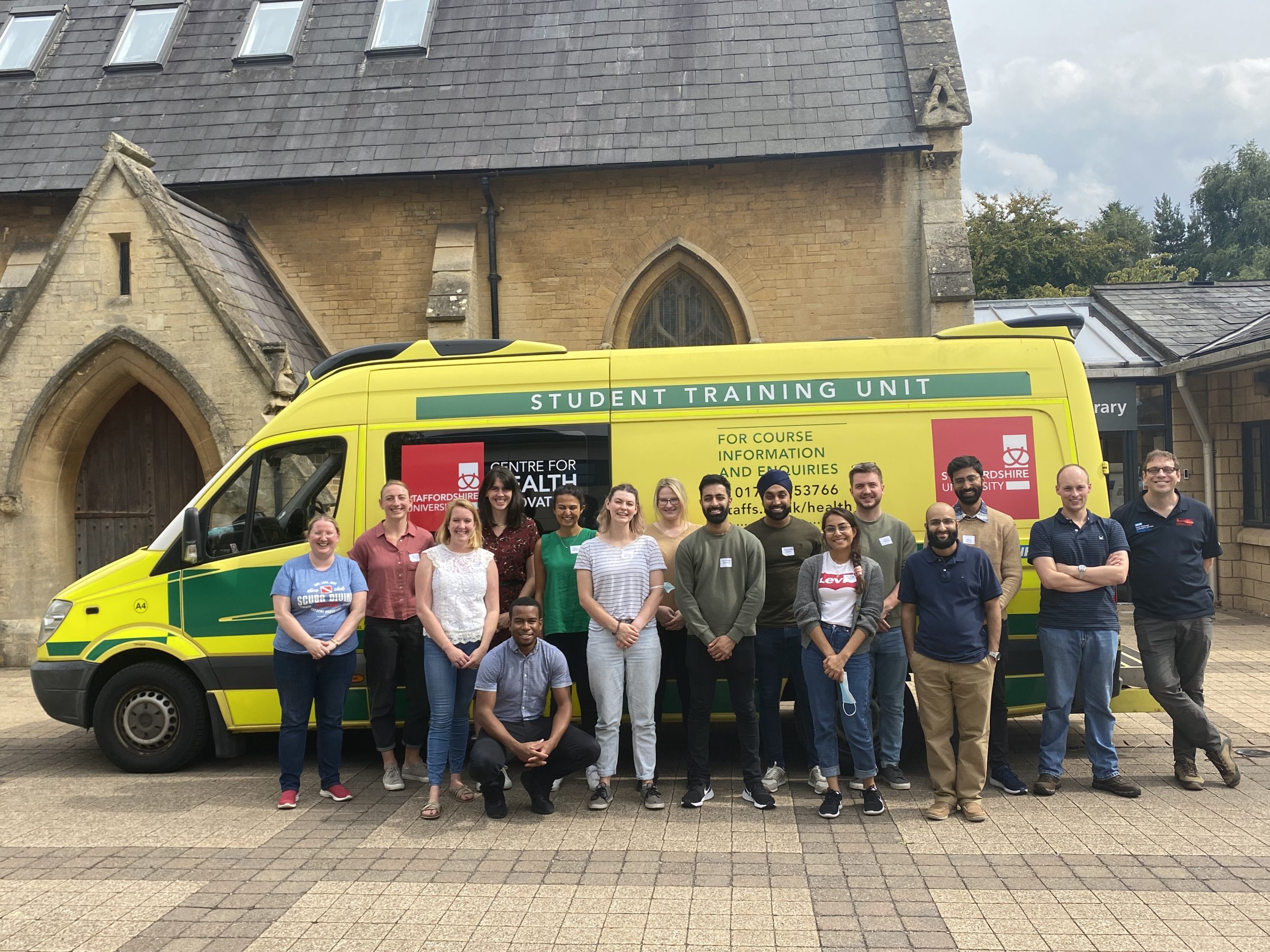
Consultant Anaesthetists Dr Felicity Avann and Dr Ben Taylor ran the one-day Course at Stafford Post Graduate Medical Centre (making use of the new Extended Reality Laboratory) and received great feedback:
- Really good hands-on experience with the ambulance and sim suite!
- Fantastic session, led by expert faculty. Very much appreciated! Well organised and great facilities.
- Really enjoyed the day. Enthusiastic, proactive, approachable teachers. So many hands on tips!
- The session was excellent, in part because of the high quality of trainers and their experience level/background. Use of the ambulance and sim lab added to the experience.
It looks like everyone enjoyed the day!
The school aims to provide an annual Transfer Training Session, so if you are interested in attending the next one, make sure you are signed up to the mailing list on this website.
FRCA Reveal: The FRCA Revision App

The GAS Newsletter: Call for Articles
The GAS our popular Trainee newsletter is looking for new articles from Trainees around the country. Please see link below for the guidelines for articles:
The Gas Newsletter | The Royal College of Anaesthetists (rcoa.ac.uk)
If any Trainee’s are interested in having an article published in Gas to email gas@rcoa.ac.uk or kmorris@rcoa.ac.uk
Karen Morris | Regional Representatives Coordinator Royal College of Anaesthetists Churchill House | 35 Red Lion Square London | WC1R 4SG Email: kmorris@rcoa.ac.uk Direct Line: +44 20 7092 1573 Switchboard: +44 20 7092 1500 Web: www.rcoa.ac.uk | Twitter: @RCoANews   |
Anaesthetists Improve Skills Thanks to Life Size Robotic Patient
Anaesthetic staff at University Hospitals of North Midlands NHS Trust (UHNM) are now able to improve their skills thanks to a life-size robotic patient. Staff in the Royal Stoke University Hospital’s Anaesthetic Academic Unit can now simulate procedures and practice on the SimMan 3G, which was funded thanks to a grant from the Denise Coates Foundation to UHNM Charity.
Dr Lloyd Craker, UHNM Consultant Anaesthetist, said: “SimMan 3G is able to display a wide range of physiological and neurological symptoms as well as pharmacological responses to almost 150 different drugs. It enables us to provide simulation training on specialities including point of care ultrasound, advanced ventilation management and patient monitoring.” As well as being able to talk through microphones, SimMan has eyes that open and close with responsive pupils and it is able to cry, sweat and pass water. It has realistic cardiac and abdominal sounds, and can also simulate bleeding and convulsions.
The funding has also enabled the Anaesthetic Department to purchase a range of respiratory and ultrasound training equipment.
Dr Craker added: “The response to the pandemic means different ways of working to protect the safety of our patients in these high-risk environments. This training equipment is essential for that. Much of our previous training equipment was old, outdated and very much overused. This new equipment provides our staff with experience, competence and confidence.”
The Denise Coates Foundation’s generosity in providing the funds for this state of the art training equipment will benefit the training of many junior anaesthetists and other healthcare staff for years to come and we thank them most sincerely.
If you would like to fundraise for UHNM Charity visit www.uhnmcharity.org.uk for more information, or call 01782 676444 to speak to one of the UHNM Charity team.


Medical Devices and Acute Pain Team Improving Patient Outcomes

Effective analgesia or pain relief is crucial to patient outcome following surgery or trauma, to ensure comfort and to aid rehabilitation.
Local Anaesthetic (LA) infusions for the management of acute pain in trauma patients and more recently groups of post-operative surgical patients have been implemented in the Trust. Local Anaesthetics are a key part of acute pain management and has benefits of reduced strong pain-relieving drugs requirement and consequently a reduction in opioid related side effects.
Local Anaesthetic catheter insertion to enable the infusion relies on skilled clinicians and the Medical Devices Team along with the Acute Pain Team have been training nursing staff on Ward 223 to ensure staff have an understanding of both the theory and practical aspect.
Advanced Nurse Practitioner and Nurse Lead for the Acute Pain Service Lotta Blake-Jansson focuses on the theory and competence of knowledge surrounding LA infusions and Mandy Wilkes, Medical Devices Trainer develops and assesses competence with the infusion device.
Despite the pandemic ward 223 have managed to support their staff to receive the training package and are 100% complaint ,meaning as a cardio thoracic ward they can lead the way to take patients with the LA infusions improving patient outcome.
Lotta Blake-Jansson said: “This demonstrates the good work that has been going on during the pandemic but also raise awareness of Local Anaesthetic infusions and the positive impact it has on patients.
“Nursing , medical and other disciplines use a wide variety of infusion devices on a daily basis to deliver safe and effective care and to minimize risk to our patients , it is important that all staff are trained and competent with all the devices they use.”
Mandy Wilkes added: “My role sits within Quality, Safety and Compliance and the monitoring of compliance, planning and facilitating medical device training is a fundamental part of my role.
Collaborative working is essential especially when a new device is being launched, this ensures staff are receiving a structured, streamlined approach to training that incorporates both theory and practise. The Local anaesthetic training is a prime example of how collaborative working has excellent benefits for both staff and patients.”
The Bodyguard 595 infusion device is specifically for Local Anaesthetic infusions and is for the management of acute pain in Trauma patients and more recently groups of post-operative surgical patients.
If you require more information or training on Local Anaesthetic infusions please email
Consultants’ Book on Chronic Pain Management Receives Critical Acclaim
Dr Pradeep Ingle, Consultant in Chronic Pain and Anaesthesia, has co-authored a critically acclaimed book: ‘Chronic Pain Management’. The book was written alongside other clinical experts and was released last month in a charity event organised by ‘RISE’ foundation, which helps children in the UK who suffer from chronic pain.
Chronic or persistent pain is defined as pain which carries on despite medication or treatment. Most people recover following an injury or operation, but sometimes pain can carry on for longer or come on without any history of an injury or operation. Chronic pain can also affect people living with diabetes, arthritis, fibromyalgia, irritable bowel and back pain.
Dr Pradeep Ingle said: “This book will help medical professionals gain a sound understanding of chronic pain and advises on the diagnosis and management of various pain conditions they are likely to encounter in their practice. The book also discusses pain management in special populations and challenging situations and it covers other important topics in pain medicine, including issues relevant to primary care, pain medication, pain interventions and pain management in difficult times such as the Covid-19 pandemic.
“I’m really pleased that the book has been so well received. Reviews mention that it contains a good range of topics which are succinct and easy to understand and which have concise evidence-based practice recommendations. All the main authors of this book are involved in conducting various educational courses related to pain and anaesthesia in the UK, so I’m hopeful that it will be a very useful tool for anaesthesia trainees and that the simple and consistent style will make it an easy read.”
UHNM consultants Dr Harry Murally, Dr Rajini Sundararajan, Dr Ashok Puttappa and Dr Vanja Srbljak also contributed to the book, which covers topics relevant in day-to-day practice for various healthcare professionals such as Anaesthetists, ITU professionals, General Practitioners, Rheumatologists, Physicians, Surgeons, Junior Doctors involved in community and hospital pain management settings, Physiotherapists and Musculoskeletal Pain Practitioners, nursing staff and medical students.
Copies of the book can be ordered here.
