
International Study Leave Form
The International Study Leave Form is now available on the Stoke School Website here http://stokeanaesthesia.org.uk/trainees/
The International Study Leave Form is now available on the Stoke School Website here http://stokeanaesthesia.org.uk/trainees/
A huge well-done to Consultant Cardiac Anaesthetist, Dr Fang Lam and his colleagues Senior Cardiac Perfusionist, Jennifer Birtwistle and Acting Chief Cardiac Perfusionist, Christopher Knott, who completed a 200 mile bike ride to raise awareness of undiagnosed Valve Disease!
Read more here –
Consultant Anaesthetist and Clinical Fellow Vijay Jeganath at UHNM has received the Top 50 Healthcare Leaders Award at the 2018 Smart Health Conference in Dubai.
The conference brings together more than 500 healthcare professionals from across the world with the mission of improving healthcare, by facilitating an open dialogue between the different industries.
Congratulations, Vijay!

Congratulations to Dr Victoria Millington who recently won the RWT’s Education Academy & Innovation Award 2018.
This is in recognition of her clinical work in Anaesthetics.
Well done Victoria!
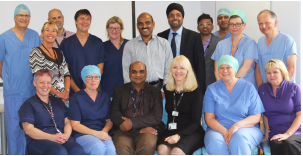
UHNM’s maxillofacial cancer surgery and anaesthetic team have become the first in the country to offer 3D computer modelling, printing and reconstructive surgery all under one roof. The innovative technology, which is used as part of facial reconstruction in cancer patients, enables clinicians to restore features using exact, customised models. The same team has also introduced an airway management technique called ‘THRIVE’, which uses high flow and humidified oxygen to safely sedate and maintain oxygenation during the prolonged apnoeic period before patients go to sleep.
Dr Pramod Nalwaya, Consultant Anaesthetist, said: “Being able to provide the 3D printing and modelling service under one roof has enabled us to reduce operating times and thereby help to reduce the costs of this surgery. Using the THRIVE technique has helped to improve patient experience and make the whole procedure safer, smoother and faster with reduced complications.
“These are two examples of outstanding innovation at UHNM and I am extremely proud of all the team. There has been a significant expansion in the number of complex and prolonged operations carried out by clinicians from 3-6 per year to more than 30, with duration of procedures ranging from 12-26 hours. This demonstrates the motivation and dedication of staff, who work very hard together to manage such complex and long operations and deliver high quality care for patients on a continuous basis. All patients are looked after by the same team, which helps to streamline the pathway of patients from pre-admission to theatre and discharge. This team approach helps to strengthen working relationships and results in better care for our patients.”
The team have been given the Chief Executive’s Award in recognition of their achievements.
Paula Clark, Chief Executive, said: “It is amazing to see the results of the work of this team, which truly have the power to transform people’s lives. I am so impressed to see the dedication and work ethic of staff here and what it has achieved. This is another example of extremely high-quality care being provided at UHNM and I am thrilled to be able to recognise the team’s work in this way.”
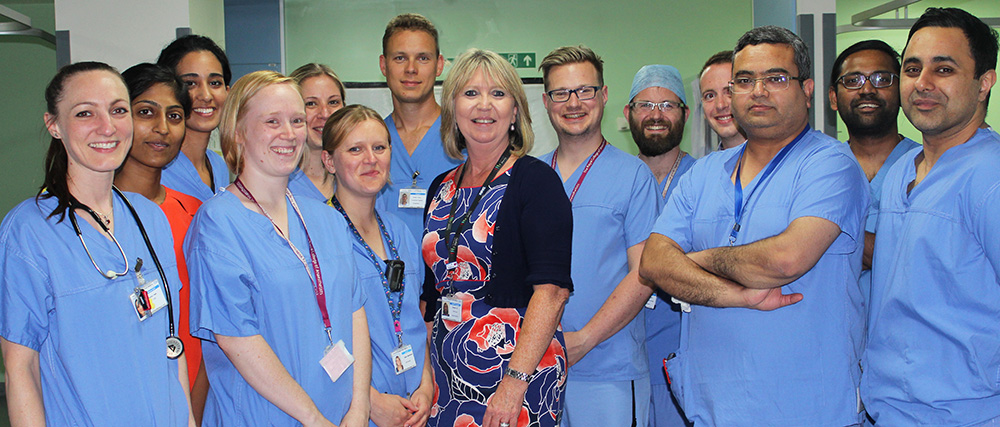
Congratulations to the Trainee Anaesthetist Team at UHNM, who have been awarded Team of the Month, June 2017!
The accolade was notified in the latest UHNM Bulletin with a presentation by and photograph with Chief Nurse, Liz Rix.
Well done team!
Click the Link to read more about Team of the Month – June 2017
Hello all
Trauma and stabilisation is intended to be delivered over the course of a whole training period (basic, intermediate, higher or advanced). I understand, and expect, therefore that this means I’ll be busy with requests for module completion forms in the run up to ARCPs.
Paperwork
– I suggest making an entry in your logbook (under miscellaneous) for all trauma calls you attend whether they happen at Stoke or in the trauma units that are in the rotation. This will allow you to record supervision, airway management and procedures. In the ‘operation’ field I suggest writing Trauma call – (type of injuries / destination, e.g. ED only / theatre / IR / ICU).
– WPBAs required are outlined in the trainee workbooks
Trauma courses
The intermediate workbook requires ATLS or equivalent only if you are not able to achieve the learning outcomes of the intermediate trauma module. However, ATLS (or preferably something better!) does help meet the learning outcomes considerably….
Case numbers / exposure
There won’t be a case number target – I’ll look at the core learning outcomes for each module and take into account complexity, range and supervision of cases together with any other learning (courses, elearning, CPD etc).
The intermediate training block is probably the most challenging to achieve since trauma calls at RSUH are attended by RAC / Consultant – getting to trauma calls as St3/4 is difficult and I appreciate this. But there are opportunities and you will hopefully encounter these cases in the trauma units as well.
Advanced training
If anyone in intermediate / higher training has ambitions of attending trauma calls at 0200 well in to their middle age then please do get in contact with me and we can plan an advanced module
Suggested reading
I recommend you have a look at 3 papers for a good overview on the limitations of ATLS, tension pneumothorax dogma vs real life and an education article on major haemorrhage management
http://onlinelibrary.wiley.com/doi/10.1111/anae.13166/full
http://emj.bmj.com/content/22/1/8
https://academic.oup.com/bjaed/article/14/6/251/247523/Management-of-haemorrhage-in-major-trauma
Shameless plug……
If you’re looking to do a quick bit of elearning can I suggest the doctors.net.uk module on immediate management of major trauma? I’m not paid per user!
https://www.doctors.net.uk/ecme/wfrmNewIntro.aspx?moduleid=1646
Hope that’s helpful
Thanks
Alex
| Alex James
Consultant, Trauma Resuscitation and Anaesthesia |
| Anaesthetics Department
Royal Stoke University Hospital University Hospitals of North Midlands NHS Trust
Email: alex.james@uhnm.nhs.uk Mobile: 07976 839567 |